Changing careers into project management can feel like showing up with strong work habits and no obvious label for them. You may already coordinate people, deadlines, and handoffs, yet your resume doesn’t say “project manager.”
That’s where entry-level project management certifications help. The right one gives employers a clear signal, but the wrong one can waste time or money. Start by picking the credential that fits your target role, not the one with the loudest hype.
First, know the difference between a certificate and a certification
A certificate program shows that you completed training. A formal certification shows that you met eligibility rules and passed a standardized exam. Both can help, but they don’t mean the same thing in hiring.
The Google Project Management Certificate is a training program. CAPM, CompTIA Project+, and PRINCE2 Foundation are exam-based credentials. On a resume, that difference matters because many employers treat coursework and third-party validation as separate signals.
Recent job searches in 2026 show thousands of entry-level project coordinator openings in the US, with pay often landing between $45,000 and $70,000. Many of those jobs ask for scheduling, communication, status tracking, spreadsheets, and project tools. A beginner credential supports that story, but it doesn’t replace it.

Your first goal is interview credibility, not a senior title.
Most career changers should not start with PMP. PMI’s PMP eligibility page still requires months of project leadership experience, so it sits further down the road.
The strongest beginner options in 2026
This comparison keeps the main trade-offs in one place.
| Option | Type | Prerequisites | Typical cost | Time to finish | Exam and difficulty | Renewal | Employer recognition |
|---|---|---|---|---|---|---|---|
| CAPM | Formal certification | High school diploma or equivalent, 23 hours of PM education | $225 to $300 exam, plus course cost if needed | 1 to 3 months | 150 questions, 3 hours, medium difficulty | 15 PDUs every 3 years | Strong, broad, global |
| Google Project Management Certificate | Certificate program | None | About $49 per month, often $100 to $300 total | 3 to 6 months | No proctored exam, lower pressure | None | Good for beginners, lighter signal |
| CompTIA Project+ | Formal certification | None, some exposure helps | $349 exam, training extra | 1 to 2 months | Up to 90 questions, low to medium difficulty | Verify current policy before purchase | Solid in tech, mixed elsewhere |
| PRINCE2 Foundation | Formal certification | None | $300 to $500 exam, training often extra | A few days to 1 month | 60 questions, 60 minutes, low to medium difficulty | No expiry for Foundation | Strong in UK, Europe, public sector |
The short takeaway is simple. CAPM carries the strongest beginner signal in many markets. Google’s program is the easiest on-ramp. Project+ fits tech-leaning paths. PRINCE2 Foundation matters most where formal process language already matters.
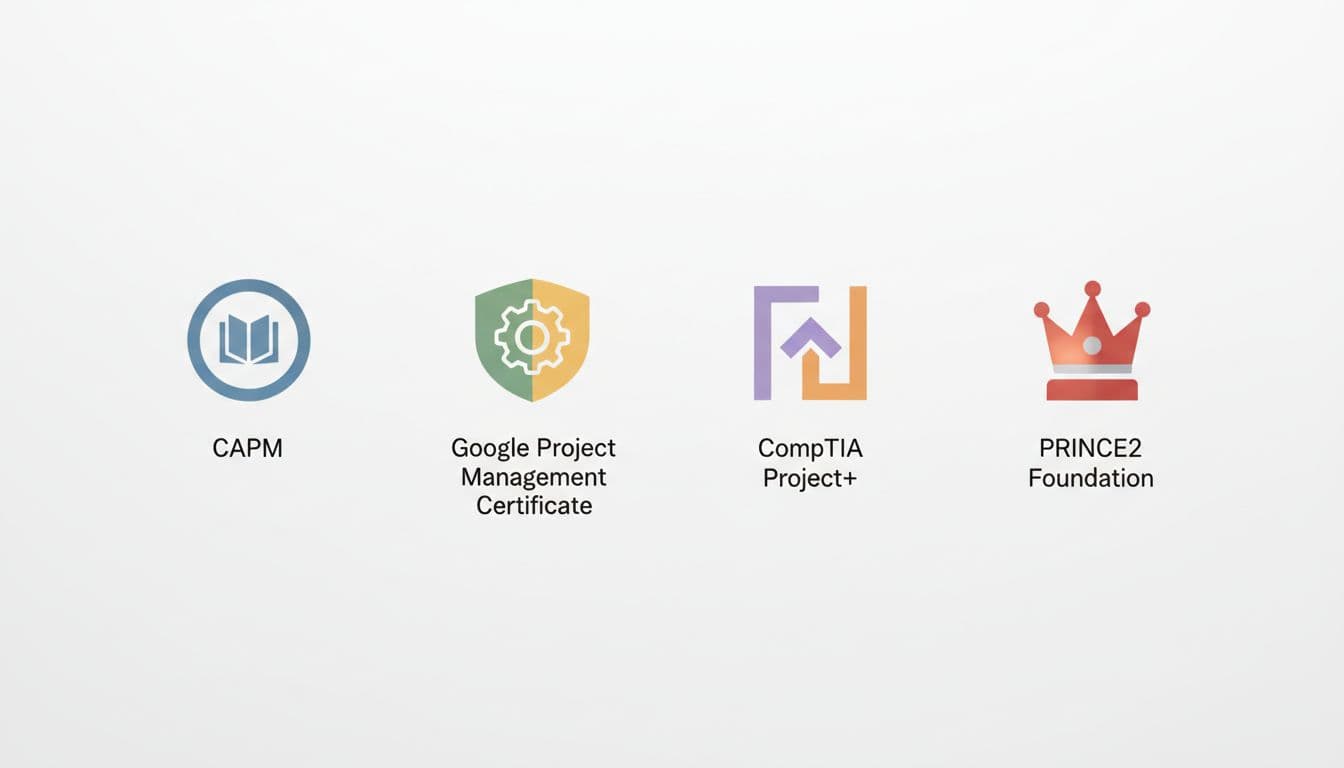
CAPM is the safest first formal certification for many career changers. According to PMI’s CAPM requirements, you need a secondary diploma and 23 hours of project management education, but no work experience. The upside is employer recognition and a clear path toward PMP later. The drawback is the exam. It’s not brutal, but it does take focused study.
Google Project Management Certificate is the easiest place to begin if you need structure, lower cost, and no exam anxiety. Coursera’s overview of beginner options places it among the best starting points for new PMs. The program teaches common workflows, Agile basics, and tools. The downside is that employers may read it as training, not independent validation.
CompTIA Project+ sits between those two. It is vendor-neutral and practical, which makes it useful for people moving from IT support, operations, or technical coordination. The exam is shorter than CAPM, and the content is easier to map to small-project work. Recognition is decent, not universal. Also, published renewal details conflict across third-party sources, so confirm the current policy before registering.
PRINCE2 Foundation works best in process-heavy settings. It is well-known in the UK, Europe, and many public-sector environments. In the US, recognition is less consistent. The exam is manageable for beginners, and the Foundation level doesn’t require renewal. Still, if you’re applying mostly to US private-sector roles, CAPM usually gives you wider reach.
None of these credentials guarantees a job. Employers still want proof that you can organize work, follow through, and keep people informed.
Which certification should you choose first?
For most career changers in 2026, CAPM is the best first choice if you want the strongest exam-based signal and can study seriously for a few weeks. If money is tight, or you need a gentler start, Google’s certificate is the better first step.
- Pick CAPM if you want the most widely recognized beginner credential and may pursue PMP later.
- Pick Google’s certificate if you need guided learning, a lower upfront cost, and basic PM vocabulary fast.
- Pick Project+ if your target roles sit close to IT, operations, or technical project coordination.
- Pick PRINCE2 Foundation if you’re targeting the UK, Europe, government, or companies that use formal process methods.
A certificate program can be enough to land interviews when your past work already includes coordination. Admin staff, marketers, teachers, healthcare workers, and operations specialists often have usable examples. Rewrite that experience in project terms: timelines, stakeholders, vendors, risks, budgets, status updates, and follow-up.
If your background has little overlap, pair the credential with proof. Build two or three small portfolio pieces, such as a project charter, a simple timeline, a risk log, or a weekly status report. Then aim at project coordinator, project analyst, or PMO coordinator roles first. Many listings still ask for one year of experience, but recent searches also show hundreds of no-experience openings under coordinator titles.
Conclusion
The best starting point depends on what kind of proof you need most. If you want the strongest formal signal, choose CAPM. If you need a cheaper runway and structured learning, start with Google’s certificate.
That half-finished career map gets clearer once you pick one path and back it with evidence. A first credential opens the door, but your translated experience and small portfolio are what help you step through it.
Leave a Reply