
A project can wobble before the first task starts. That usually happens when no one agrees on the goal, the limits, or who has the final say.
For any project manager, creating a project charter is the most critical step during the project initiation phase. Effective project management starts with alignment on project goals. A strong project charter fixes that early. It gives the team a shared starting point, without burying them in detail. For a new project manager, that matters more than fancy wording.
Key Takeaways
- A project charter is the project’s green light: it authorizes work, defines high-level scope, names the sponsor and team, and aligns everyone before execution starts—crucial for new project managers to avoid early confusion.
- Keep it simple and one-page: focus on purpose, 1-3 SMART objectives, in/out scope, key stakeholders, deliverables, assumptions, top risks, budget estimate, and approval signature; skip detailed plans or task lists.
- Use for projects needing approval, crossing teams, or with fixed budgets/deadlines; skip tiny, routine tasks—templates and examples like office moves or CRM rollouts show the pattern.
- Get approval fast by sharing a draft early, focusing meetings on goal, scope, and resources, then pointing to the charter later to hold the line on changes.
When a project charter helps, and when it doesn’t
Think of a Project Charter as the project’s green light. It gives formal approval, names the Project Sponsor, and draws a box around the Project Scope for the Project Team. If the project is large enough to need funding, people, or cross-team support, you probably need one.
A Project Charter is not the same as a Business Case or a Project Plan. The Business Case justifies the investment and explains why the work is worth doing. The Project Plan explains how you’ll do it. The Project Charter sits in the middle. It provides formal authority and turns the idea into an approved project.
A Project Charter authorizes the work. A Project Plan organizes the work.
Use a Project Charter when the work has one or more of these signs:
- It needs sponsor approval before people can start.
- It crosses team lines, so ownership could get fuzzy.
- It has a fixed date, budget cap, or public deadline.
- It could drift unless Project Scope is written down early.
Skip the long form if the work is tiny, repeatable, and already covered by normal team processes. A two-hour office supply reorder does not need a Project Charter. A three-month CRM rollout probably does.
New Project Managers often make the Project Charter too big. They add task lists, full schedules, or long risk logs. That turns a starter document into a planning file. For a Project Manager, using a Project Charter Template can prevent over-complicating the document. If you want to compare formats, Wrike’s guide to project charters and ProjectManager’s charter examples and template both show the same pattern: keep it high-level, clear, and brief.
Key elements every simple charter should include
A good project charter reads like a short map. It tells people where the project is going, what road it will take, and where the road ends.

Use this table as a simple model:
| Element | What to write | Keep it short by |
|---|---|---|
| Project purpose | Why the project exists | Use one plain-language problem statement |
| Project Objectives | What success looks like | Add 1 to 3 measurable outcomes |
| Project Scope | What’s in and out | Name the edges, not every task |
| Stakeholders | Who matters most | List sponsor, PM, team lead, key users |
| Key Deliverables | Primary outputs of the project | List 3 to 5 critical items |
| Project Assumptions | Conditions assumed to be true | Note 2 to 4 key ones |
| Risks and constraints | What could block progress | Include only the top few items |
| Approval | Who signs off | Name the decision-maker clearly |
That core is enough for most early-stage projects. A simple project charter like this helps you hold the line later. When someone asks for extra work, you can point to the project scope section instead of arguing from memory.
The project charter should also outline a high-level budget estimate and include a brief risk assessment. Make success criteria and roles and responsibilities clear for all stakeholders, especially so the project sponsor can sign off quickly. Major milestones belong in the project charter, but the granular project timeline belongs in the project plan.
What should you leave out? Skip the full work breakdown structure, detailed budget math, vendor terms, meeting cadence for stakeholders, and every minor milestone. Those belong in the project plan or other support files.
A short project charter also makes approval easier. The project sponsor rarely wants a ten-page memo. They want to see the goal, the budget estimate, the main risks from the risk assessment, success criteria, roles and responsibilities for key stakeholders, and the owner. If you need another format to compare against, Tempo’s project charter template guide and the Institute of Project Management’s charter overview are helpful reference points.
Project Charter Examples New PMs Can Adapt
The best way to learn project management is to see the pattern in motion. These Project Charter Examples provide a One Page Project Charter format for various scenarios. They are short on purpose, because most real project charters work better when they fit on one page.
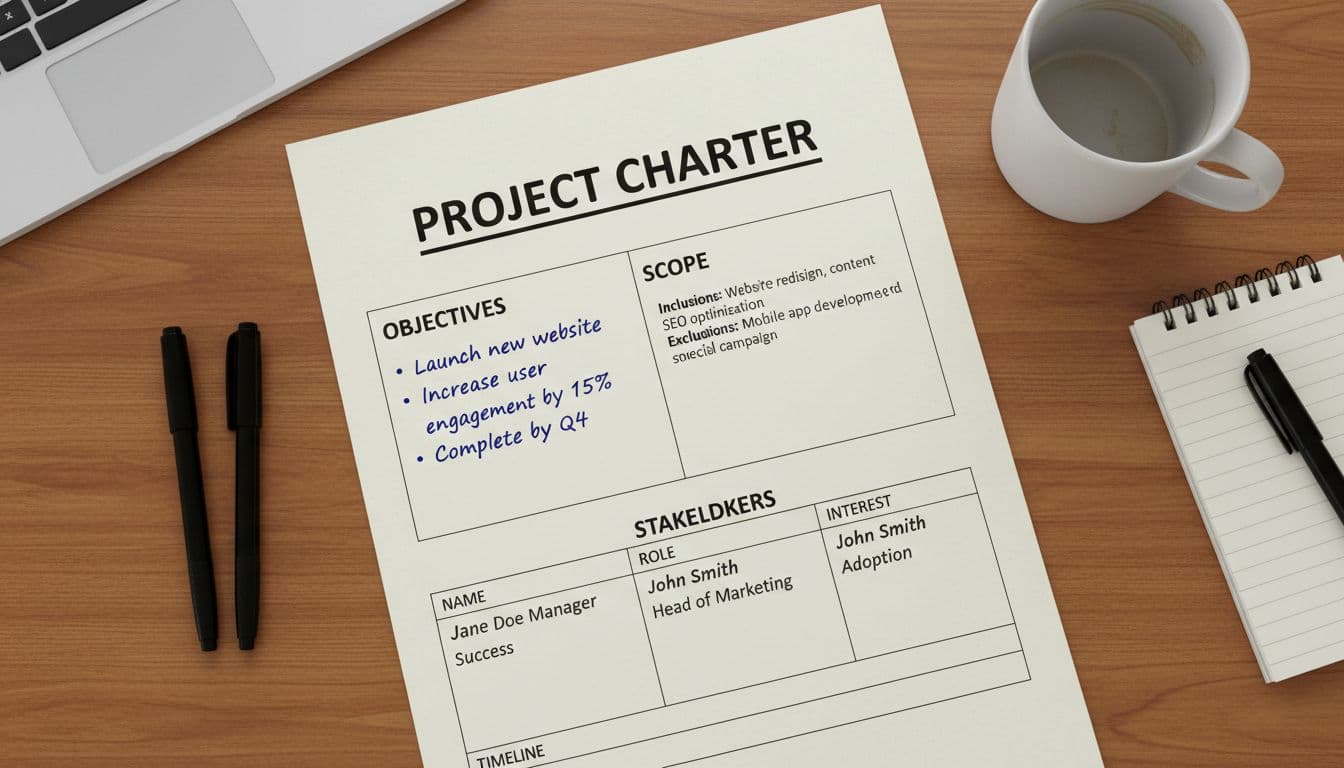
Example 1: Office relocation
| Field | Sample entry |
|---|---|
| Purpose | Move 75 staff to a new floor before lease expiry |
| SMART Goals | Complete move by August 15 per the project timeline with less than one day of downtime |
| In scope | Furniture move, IT setup, seating plan, move-day support |
| Out of scope | Department restructures, new phone system |
| Sponsor | Operations Director |
Example 2: CRM rollout
| Field | Sample entry |
|---|---|
| Purpose | Replace outdated sales tracking with one shared CRM |
| SMART Goals | Launch to 40 users by Q3, with 90 percent adoption in 60 days |
| In scope | Configuration, data migration, training, pilot testing |
| Out of scope | Full marketing automation rebuild |
| Sponsor | Head of Sales |
Example 3: New employee onboarding redesign
| Field | Sample entry |
|---|---|
| Purpose | Cut first-week confusion for new hires |
| SMART Goals | Reduce onboarding completion time from 10 days to 5 |
| In scope | Welcome checklist, manager guide, first-week schedule |
| Out of scope | HR system replacement |
| Sponsor | HR Manager |
Notice the pattern. Each project charter example states the problem, names the finish line, and draws a border around the work. This approach supports resource allocation by defining who is on the project team. That’s the heart of a useful project charter.
How to get approval without a long email chain
Send a draft before the approval meeting, not during it. That gives your sponsor and other stakeholders time to react while the document is still easy to change. This project charter also serves as a project brief to align stakeholders before project execution begins.
Then guide the review around three decisions: Is the goal right? Is the scope clear? Is this worth the people and money requested for the project team and resource allocation? If those answers are yes, ask for a direct approval. Don’t end with, “Let me know your thoughts.” Focus on getting stakeholders aligned early.
Keep the meeting short. Walk through the purpose, SMART goals, scope, risks, sponsor role, and key stakeholders. If someone wants detailed timelines, tell them that belongs in the project plan. That small line protects the project charter from turning into a junk drawer.
If needed, add a vision statement and a high-level communication plan to your project charter template.
A blank page can feel heavy. Still, a project charter doesn’t need to sound grand. It needs to be clear enough that a sponsor and stakeholders can approve it and a project team can act on it.
Start with one of these project charter examples, trim anything too detailed, and ask for sign-off early. A clean project charter at the start can save weeks of confusion later.
Frequently Asked Questions
What is a project charter?
A project charter is a short document that formally approves a project, defines its high-level scope, objectives, and key stakeholders. It gives the project manager authority to proceed without diving into detailed planning. Think of it as the project’s starting map, sitting between the business case (why do it) and the project plan (how to do it).
When should you create a project charter?
Create one for projects needing sponsor approval, crossing team lines, with fixed budgets or deadlines, or at risk of scope drift. Skip it for small, repeatable tasks covered by routine processes, like a quick office supply order. New PMs benefit most when the work justifies alignment upfront.
What are the key elements of a project charter?
Include project purpose, 1-3 SMART objectives, in/out scope, stakeholders (sponsor, PM, key users), major deliverables, assumptions, top risks/constraints, high-level budget, and approval sign-off. Use tables for clarity and keep it to one page. Leave out detailed timelines, full budgets, or task lists—those go in the project plan.
How do you get project charter approval?
Send a draft to the sponsor and stakeholders before the meeting for feedback, then focus the discussion on the goal, scope, risks, and resources. Ask directly for sign-off once aligned, and use it as a reference to protect scope later. Keep meetings short to respect their time.
What’s the difference between a project charter and a project plan?
The charter authorizes and outlines the project at a high level; the plan details how to execute with tasks, timelines, and resources. A charter prevents drift by setting boundaries early; the plan organizes the work inside those boundaries. New PMs often confuse them by overloading the charter with plan details.
Leave a Reply